Search
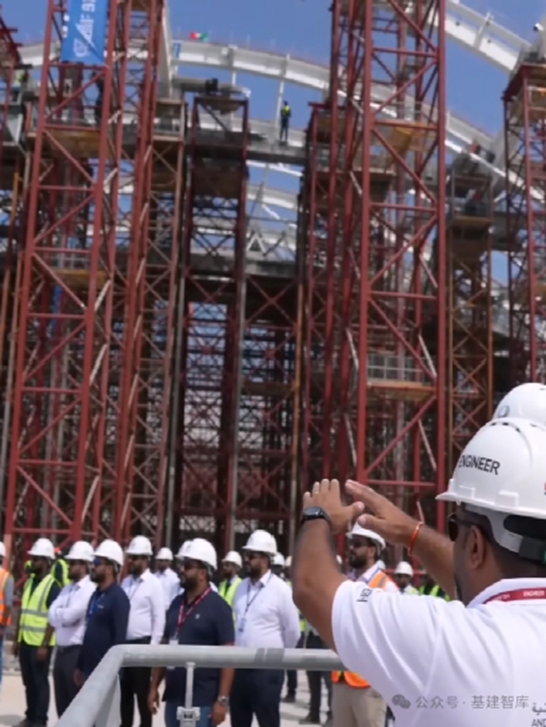
At the construction site of the Abu Dhabi International Airport project, a scene once unfolded that many Chinese companies entering the Middle Eastern market may find familiar. A carefully planned tower crane lifting scheme prepared by Chinese engineers was rejected on the spot by the general contractor’s engineer, who offered only a brief comment: “Not acceptable.” The contractor of this project was China State Construction Engineering Corporation, the same company that successfully built the Beijing National Stadium (the “Bird’s Nest”). This moment may well represent the experience of many Chinese enterprises expanding into the Middle Eastern market. Beneath the seemingly free-spending, flexible environment often associated with the region lies a rigorous, highly integrated system of international standards. Any misunderstanding or misinterpretation of these standards can quickly lead to costly consequences. According to data from China’s Ministry of Commerce, the total turnover of overseas contracted projects completed by Chinese enterprises in the Middle East increased by 12.7% year-on-year in 2023. However, among cases involving project delays and cost overruns, more than 60% were directly related to misinterpretations of standards and technical specifications, costing companies millions in “tuition fees.”
Rigid Constraints of European Standards: Lessons from the Rejection of a Lifting Plan
At the early stage of the Abu Dhabi International Airport project, the Chinese team entered the site with great confidence, backed by experience from landmark projects such as the Beijing National Stadium (the “Bird’s Nest”). When the team proposed using a tower crane tandem lifting method—a highly efficient operation widely used in domestic projects—the plan was immediately rejected by the foreign lifting engineer on the grounds that it did not comply with European standards. A review of the relevant European code, EN 1993-6 (Eurocode 3 – Design of Steel Structures: Crane Supporting Structures), reveals a clear provision stating that tower cranes should not be used for tandem lifting operations. This requirement stems from the conservative load-combination philosophy embedded in the Eurocodes. During tandem lifting, any lack of synchronization between cranes can cause the dynamic load factor to increase exponentially, potentially leading to structural instability or failure. Even after the project team worked overnight to develop an optimized solution—incorporating an anti-collision spreader beam system and successfully passing the owner’s simulation-based verification—the proposal was still vetoed by the project’s safety manager, who cited the same clause in the European standard. Ultimately, the project team had no choice but to cut the structural components into smaller sections and lift them separately. This adjustment resulted in additional time and cost. The change alone caused a 23-day schedule delay and increased direct costs by approximately 1.8 million RMB.
This experience led the project team to a profound realization: in overseas engineering projects, what Chinese engineers may regard as “routine practice” can be considered a clear violation of regulations under international standards. More importantly, the wording used in European standards often carries a different legal implication than its literal translation suggests. The phrase “not recommended” in Eurocodes, for instance, is frequently interpreted in Chinese as something “open to negotiation.” However, within the European legal and regulatory system, such wording effectively functions as a prohibition—unless a special technical justification certified by an independent third party is provided. This difference in normative language and underlying legal logic often becomes the first invisible barrier encountered during project execution in international markets.
The “Triple Certification” Barrier in the Saudi Market
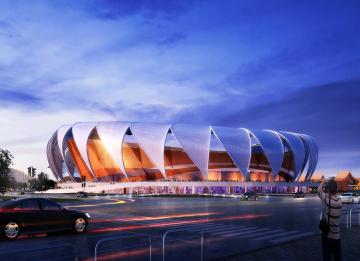
Last year, a company from Zhejiang Province secured the contract for the Jeddah Stadium project in Saudi Arabia, with a total contract value of RMB 550 million. The stadium, designed to accommodate 46,000 spectators, is expected to serve as one of the venues for the 2034 FIFA World Cup in Saudi Arabia. Although the company has already completed several major projects in Saudi Arabia—including the Jeddah Tower, King Abdulaziz International Airport in Jeddah, and the Makkah High-Speed Railway Station—making it a seasoned player in the Middle Eastern market, the firm remains highly cautious in its approach to this new project. The reason is simple: the rules of the game in the Saudi construction market are evolving rapidly.

The Core Rules of the Saudi Market
The fundamental rules of the Saudi construction market can be summarized in three key principles: materials must comply with American standards, certification must pass through the SABER system, and technical documentation must be thicker than the steel plates themselves. The Saudi Building Code SBC 306 is essentially a Saudi-customized version of the American steel design standard AISC 360, with the two standards sharing more than 85% similarity. Whether in bolted connections or welding procedures, the technical framework largely follows the American standard system. However, several key parameters have been adjusted to reflect Saudi Arabia’s local environmental conditions. For instance, due to severe salt-spray corrosion in Saudi coastal regions, the required anti-corrosion coating thickness is typically 20 microns greater than the baseline specified in American standards. Even more critical is the certification process. All steel structure products entering the Saudi market must pass certification through the SABER certification system (Saudi Arabia). Two documents are mandatory:
PC Certificate (Product Certificate of Conformity)
Both are required; missing either one can result in goods being detained during customs clearance. The SABER system is directly linked with Saudi customs databases in real time. In 2023, containers detained due to incomplete certification incurred average daily demurrage charges of approximately USD 200. A practical example is Nanyang Hanye Special Steel Co., Ltd., which supplied more than 2,000 tons of steel structures for a stadium project serving Saudi Aramco. The delivery was carefully divided into three precisely scheduled shipments. More importantly, the company secured multiple international certifications in advance, including the European Union's Construction Products Regulation (CPR) certification, ASME certification under the American standard system, and SASO certification in Saudi Arabia. This “certification-first” strategy ensured the smooth fulfillment of a contract valued at RMB 68 million.
Dubai Supertall Towers: When Physical Limits Challenge Regulatory Boundaries
The Six Senses Residences Dubai Marina project, recently awarded to China State Construction Engineering Corporation Middle East, is set to reach a height of 517 meters, making it the world's tallest residential tower upon completion. The project's technical specifications are exceptionally demanding. S460 high-strength structural steel accounts for 96% of the total steel used, with the maximum welded plate thickness reaching 160 mm, and the heaviest single structural component weighing up to 47 tons. Compared with the commonly used Q345 structural steel in many domestic projects in China, the technological gap is significant. The yield strength of S460 steel is approximately 1.33 times higher than that of Q345. However, the increase in material strength also leads to a geometric rise in welding complexity.
In practical terms, preheating temperatures and interpass temperature control must be maintained within a strict tolerance of ±5°C, placing extremely high demands on welding procedures, quality control, and construction management.
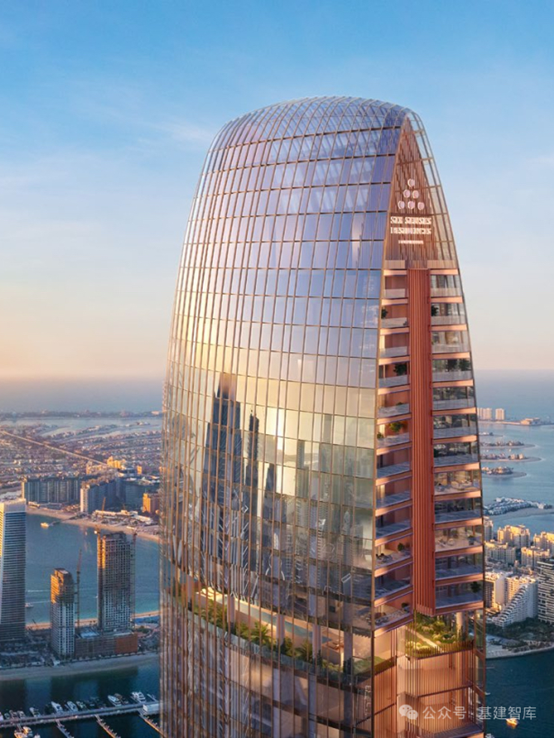
This regulatory framework—combining international standards with the challenges posed by extreme local environmental conditions—forms the technical foundation for constructing supertall buildings in Dubai.
Even more noteworthy is the extremely rigorous approval process enforced by Dubai Municipality for projects that exceed conventional design limits. For the Six Senses Residences Dubai Marina project, the steel structure design documentation underwent four rounds of expert review over nine months before receiving construction approval.
The Way Forward: From “Adapting to Rules” to “Participating in Rule-Making”
Facing the regulatory barriers of the Middle Eastern market, Chinese enterprises are beginning to adopt more proactive strategies. The approach taken by China State Construction Engineering Corporation Middle East is particularly representative. The company has established a “standards benchmarking database” that systematically compares differences among Chinese domestic codes, American standards, and European standards. To date, the database has accumulated 327 comparative cases, providing engineers with a clear reference when working across multiple regulatory systems. At the same time, the company has engaged five local consulting firms in Dubai to participate early in the concept and design stages of projects. This early involvement ensures that technical solutions comply with local regulations from the outset, reducing the risk of costly redesigns or approval delays later in the project lifecycle. A deeper breakthrough is occurring at the standard-setting level. In 2023, the China Metallurgical Group Corporation (MCC) participated in compiling the Dubai Code of Practice for Steel Structure Construction of Supertall Buildings, which was officially released that year. This marked the first time a Chinese-funded enterprise has participated in the formulation of a local engineering construction standard in the Middle East. By contributing practical engineering data and construction experience from China’s supertall building projects, Chinese companies are gradually shifting from passively adapting to international standards to actively participating in shaping them.
The Regulatory Landscape of the Middle Eastern Market
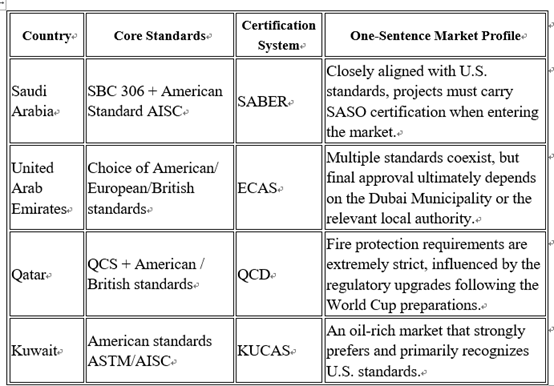
From the above cases, several key characteristics of technical regulations in major Middle Eastern markets can be identified:
Conclusion: The Market Logic behind the Rules
The strict regulatory environment of the Middle Eastern market may appear, on the surface, to be merely a difference in technical standards. In reality, it reflects a century of accumulated experience in the international engineering industry. For Chinese enterprises, going global means more than exporting construction capacity and engineering expertise. It also requires building a technical management system aligned with international standards and regulatory frameworks. From the debate over tandem lifting at Abu Dhabi Airport, to the complex certification requirements in the Saudi market, and the material and engineering limits faced by Dubai’s supertall towers, each case reinforces a simple yet powerful truth: In the international engineering market, respect for rules is the greatest protection of a company’s interests.


Copyright © Zhejiang Wanhao Group Co., Ltd. All Rights Reserved.
Sitemap | Technical Support